

Why Accredited Service Providers Will Decide How Smoothly the UAE Moves to E-Invoicing
Why Accredited Service Providers Will Decide How Smoothly the UAE Moves to E-Invoicing
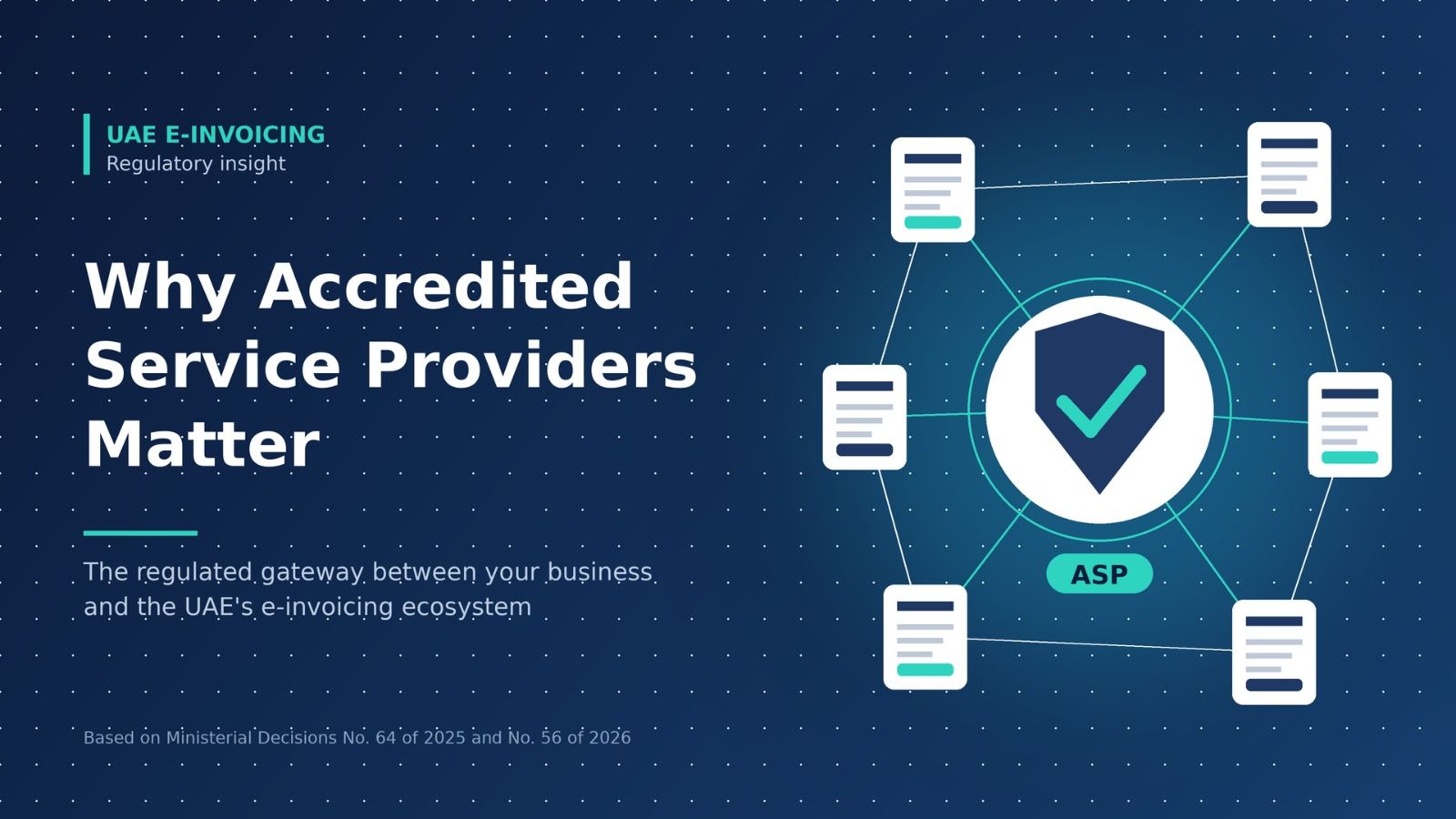
The UAE's move toward mandatory electronic invoicing is often discussed as a technology upgrade. Under the legal framework, it is also a regulated ecosystem, and the Accredited Service Provider (ASP) sits at its center.
For finance teams, tax advisors, and business owners, choosing the right ASP will be one of the most important decisions in the e-invoicing journey.
What is an ASP?
Under Ministerial Decision No. 64 of 2025, as amended by Ministerial Decision No. 56 of 2026, an Accredited Service Provider is a Peppol-authorized organization that the Ministry of Finance has formally approved to deliver Electronic Invoicing Services in the UAE.
The rule is clear: a Service Provider may only provide e-invoicing services in the State if it has obtained Accreditation. Businesses cannot simply plug into any vendor's invoicing tool. Exchanging e-invoices and credit notes in the structured format the system requires has to run through an accredited provider.
Why the ASP matters
1. It is your gateway to the system.
ASPs send, receive and exchange Electronic Invoices and Credit Notes over the Peppol Interoperability Framework, using the UAE-specific PINT AE format and the Data Dictionary. They also onboard businesses (End Users) and verify them with the Federal Tax Authority.
2. It is your link to tax reporting.
Before accreditation, an ASP must prove it can transmit Tax Data generated from e-invoices and credit notes to the Authority. For your business, this means invoicing and tax reporting can run through one compliant channel.
3. The entry bar is high, which protects you.
The eligibility criteria require, among other things:
- An active Peppol-certified status and passed OpenPeppol conformance tests
- A product that has been in operation for at least two years (the experience requirement added by Decision 56 of 2026)
- A licensed UAE or recognized foreign entity with paid-up capital of at least AED 50,000
- ISO 22301 (business continuity) and ISO/IEC 27001 (information security) certifications
- Multifactor authentication, encryption of data in transit and at rest, and regular security monitoring
- Corporate Tax registration, and VAT registration where mandatory
- Professional indemnity insurance (AED 2.5 million), crime insurance (AED 5 million) and cyber fraud insurance (AED 5 million)
- A self-declaration of no liquidation, no blacklisting, and no material financial litigation
Together, these cover financial stability, security, continuity, and insurance cover. These are the things you want from a provider that will handle your sensitive transaction data.
4. A rigorous, staged approval process. Providers go through application review, interoperability and verification testing, production certificates and trial runs, then Pre-Approval, and finally Accreditation after Tax Data reporting tests and a production trial with the Authority.
5. Ongoing oversight. Accreditation is valid for two years and must be renewed, with the application due at least 70 business days before expiry. The Ministry can request information at any time, and it can terminate accreditation if conditions are no longer met or if validated End User complaints are received. A terminated provider is delisted from the Central Register, and its End Users must be notified within five business days.
The 2026 amendment: flexibility with accountability
Decision 56 of 2026, effective 1 May 2026, made two notable changes:
- A provider may use a third-party PSP product or outsource development, operation, or management of its services, but it retains full responsibility for meeting the accreditation conditions and overseeing service delivery.
- The two-year experience requirement was formalized. It can be met by the provider or by the third party that operates the product.
This widens the market while keeping accountability with the accredited entity.
What this means for businesses
Because accreditation is time-limited and can be terminated, your ASP's status is a continuity risk for your own compliance. Before you choose, consider:
- Check the Central Register. Confirm the provider is listed as accredited, not only pre-approved.
- Look at the accreditation timeline. Ask when the accreditation was granted and when renewal is due.
- Ask for evidence. Request ISO 27001 and ISO 22301 certificates, insurance details, and data hosting and residency arrangements.
- Check readiness for your ERP. Ask how the provider integrates with your accounting or ERP system and handles PINT AE data mapping.
- Clarify outsourcing. If the provider uses a third-party product, understand who operates it and how accountability is managed.
- Have an exit plan. Know how you would migrate if your provider's accreditation ended.
- Understand the commercial terms. Providers commit to 100 free e-invoice exchange and reporting services per year from the signing of the End User agreement. Ask what applies after that.
Final thoughts
E-invoicing will make tax data more real-time, more structured and more transparent. Businesses that start early by cleaning their master data, mapping invoice fields and shortlisting accredited providers will be better placed than those who wait.
The ASP is not just a vendor. It is a regulated link between your business and the UAE's tax ecosystem, so choose carefully.
This article is based on Ministerial Decision No. 64 of 2025 and Ministerial Decision No. 56 of 2026 (unofficial English text). Implementation timelines and technical details may be updated, so please refer to the Ministry of Finance and the Federal Tax Authority for the latest guidance.
Share the post